Duns tempos pra cá, eu venho escrevendo poemas até que com uma certa freqüência. Tem sido um bom escape pra tensão das provas e trabalhos que se aproximam (o problema é que eu tenho "escapado" demais e produzido de menos). Hoje eu ocasionalmente me "inspirei" com o tema "ser adulto" e escrevi isso aí debaixo. Tomara que a alguém agrade =)
Adulto
O tempo vai passando... com ele, a gente,
sem dúvida que, quando, no porvir,
nem mais banal, nem mais adolescente
for, já seguro então vai se sentir.
Um dia então percebe estranhamente,
que adulto o é, porém, sem perceber-
se diferente do seu eu recente.
Entende: terminou-se o adolescer.
Mas aonde foi aquela segurança
que os pais passavam quando era criança,
que víamos adultos sempre ter?
Parece que não é como se pensa,
que à diferença adulto não pertença
... ou o é e eu que adulto ainda não sei ser?
-- [Versão em Português acima]
Since some time ago, I've been writing poems with a certain frequency. It's been a good escape (escape way?) for the tension of the exams and works that are coming soon (the problem is that I've been "escaping" too much and producing too less). Today I occasionally got "inspired" with the theme "to be an adult" and wrote this thing. I hope you like =)
[ok ok... again... it is a poem, with metrics and rhymes. It is virtually impossible for me to translate it to English without breaking everything. I won't even try. But don't get disappointed... soon I write some content that makes sense in English :v]
Um amigo me tinha pedido pra voltar a escrever poemas por aqui. A procrastinação falou alto, e eu acabei fazendo-o.
Atalho
Sem paz, permanece o menino,
em vão, nem insano nem são.
Sem ânimo ou fé, pequenino,
sem mimo, ao relento, sem chão.
Com tantas perguntas em mente,
confuso, ao léu, sem resposta.
Bem mal, no momento, se sente,
no tempo está sua aposta.
Não sabe se aquilo que vê
entende de forma correta;
lhe cabe, compreende, escolher
(assim desistente sem meta)
sozinho o caminho a correr.
Melhor já se sente, poeta.
--
[Portuguese version above]
A friend had asked me to start again writing poems in my blog. The procrastination was strong and I ended up doing it. Unfortunately, I write in Portuguese, and I simply can't see how to even start to translate it into English without breaking everything. Sorry to the foreigners =/
So... my hair is really long. It has been 1 year and 6 months now that I don't cut it. Funnily, many people say I look like Jesus (even people from other religions --
I will come back to this by the end
of this post) and make jokes about me multiplying breads, and transforming water into wine. At some point, I realized too much of it has been falling. Besides, I don't like the current appearance: the hair seems always "broken". I have been trying to ask different people for ways to make it look better, but keep receiving conflicting information. So... well... I must say: somehow, I am frustrated with this "problem". When talking about it this week, someone told a sentence similar to "if this is the kind of problems you have been struggling with, then your life must be pretty easy lately".
In other moments, I'd probably just agree and ignore. I never cared about my appearance (reason why I always changed it a lot), and it would be just the obvious conclusion to draw. But this time this sentence made me think. But why? Probably because I actually have cared (at least a little) about it lately. Is my life that easy? Is it somehow different than it has ever been?
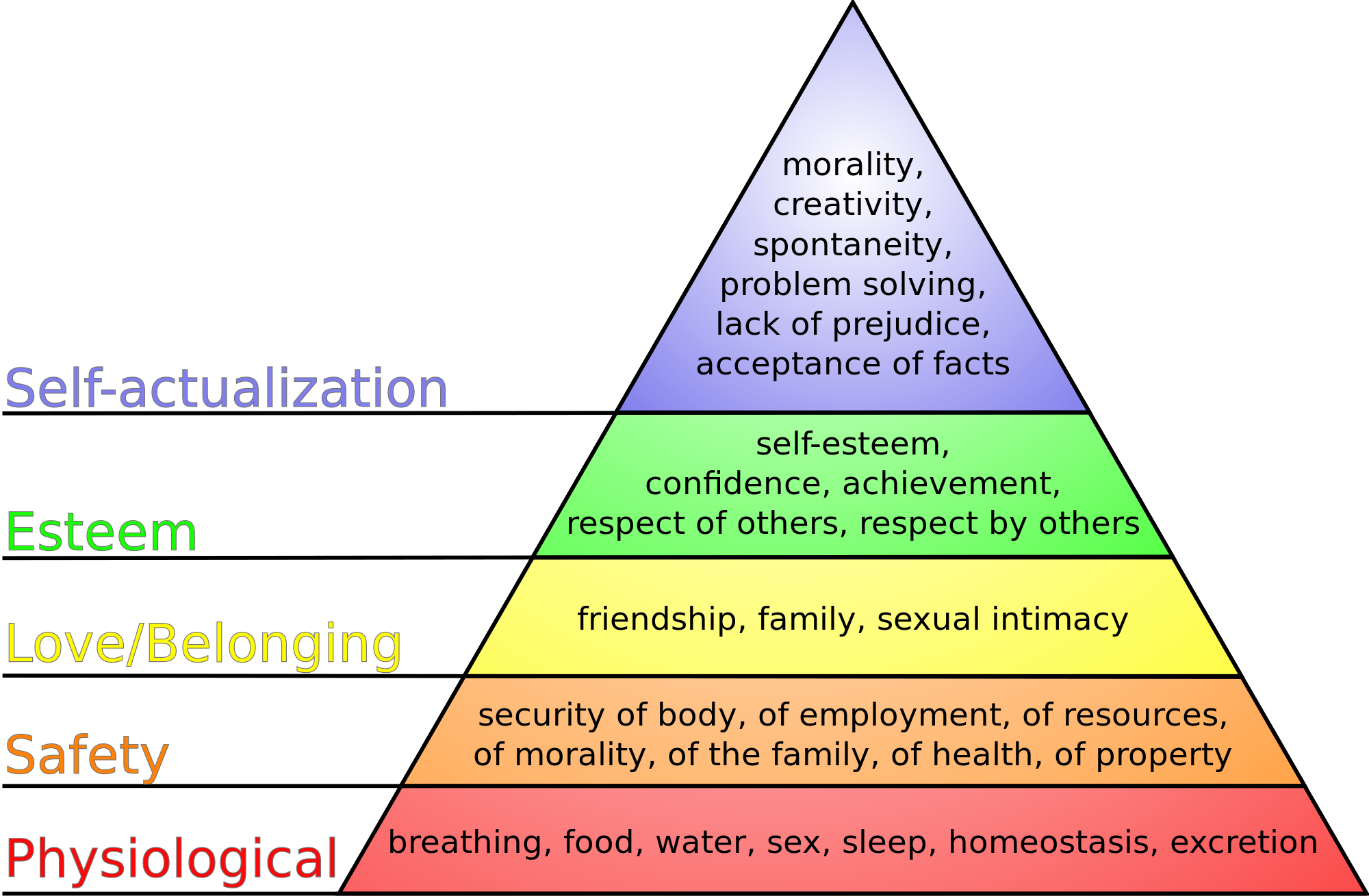
I always tend to think, when talking about different "levels" of problems, of the Maslow pyramid. Once, in a discussion about why european countries tended to give more value to humanities than poorer countries (like Brazil, in my case), a friend suggested that maybe their people (i.e., the europeans) were generally in a higher "level" of the Maslow pyramid. So, while we were still giving a lot of importance to money so that we could eat (giving importance to jobs that would earn more money, and not necessarily doing what we actually love), they, having food, would focus more on "what gives them meaning".
In fact, I could easily say that I always struggled with the "Love/Belonging" part of the pyramid. Despite being always surrounded by friends and family, I always had a serious difficulty on feeling "part" of the groups I was in. But I'd say this has been improving... and I nowadays could even say I have been finally developing some "okayer" self-esteem (which, well, any close friend would know I never had). Maybe this is a kind of problem that is completely different, after all. But is it in any way "worse" than the problems of people below the pyramid?
I always see (in 9gag, for example) lots of people complaining that women's problems (those that appear in stereotypical comics comparing women and men) are dumb problems, like "hair", "nails" or "being fat". Also, I always heard of couples that fight over petty things like "wet towel over the bed" or "the way they press the toothpaste". I think, somehow, that often what matters is not the problem, but how much someone cares about it
We often tend to dismiss other people's problems because they are not as important to us as they are to them. I always remember of my grandma, who used to put garlic in the lunch that my mom would eat, even though she knew that my mom would feel bad the whole afternoon because of it. For the grandma, mom was just being fussy (though she was already an adult); for mom, it was a serious problem.
Obviously, there should be (and I don't see how to impose) limits. If a person feels all the time threatened by some problem only he (or some of his group) sees in society, then this person probably needs help (i.e., it is probably not that society should change). I had followed for a while some discussions about safe spaces and trigger warnings in the USA, but at some point time was short and had to stop. For what is worth, I think that if a person needs trigger warnings for pretty much anything, or can't stand, for example, the usage words like violate in contexts completely unrelated to rape (like violate the law), then the person needs help!
Back to me... in previous times, I'd feel ridiculous for the kinds of problems I care about. I felt highly ashamed of them (while other people are hungry in Africa, I used to tell myself), but as my self-esteem has improved (as the result of a long process... finally leveling up in that Maslow pyramid), I started thinking about them as genuine problems, as things that I need to solve if I want to become a better person.
"A better person", in fact, can mean a lot of things. One thing I have difficulties to accept is duplicity of judgement -- reason why I hate so much lots of progressive groups that often hold that the exact same behaviors performed by different individuals are different things. I really liked the following video:
And this is where the hair/Jesus thing comes back: I keep asking myself (though I don't have major problems with it)... would those who make these kinds of jokes be willing to accept the same jokes with prominent elements of other religions? I actually am not fully sure about it. All of this thinking about problems made me start to believe that probably (and actually quite obviously, but in this context I think it makes sense to put it in words) the reason why speaking about elements of other religions is easier is that, after all, we care less about them. This explains why the same progressive groups above often have no respect by what is sacred for some... though, truly, I must say religion also often doesn't help with their causes, giving very less credit for feminism, for example. But well... this is something I don't have any strong opinion about (and I think I should stop here).
[basically... I decided to post this to see if it would help me to feel better about something I've been thinking about. Don't think it worked, but I liked the resulting post]
R$
-- [English version above]
Então... o meu cabelo tá realmente longo. Já tem 1 ano e 6 meses que eu não o corto. É engraçado que muita gente diz que eu pareço Jesus (mesmo gente de outras religiões -- voltarei a isso ao fim da postagem) e faz piada sobre mim multiplicando pães, e transformando água em vinho. Em algum ponto, me liguei que tá caindo muito cabelo. Também, eu não gosto da aparência atual: o cabelo parece sempre "quebrado". Eu venho tentando perguntar pra diferentes pessoas por formas de fazer o cabelo parecer melhor; mas fico recebendo informação conflitante. Então... bem... devo dizer: de certa forma, estou frustrado com esse "problema". Quando conversando sobre isso essa semana, alguém me largou algo como "se esse é o tipo de problema que tu tem tido, então tua vida deve estar bem fácil ultimamente".
Em outros momentos, eu provavelmente apenas concordaria e ignoraria. Eu nunca me importei com minha aparência (razão pela qual eu sempre a mudei affuuuu), e essa seria simplesmente a conclusão óbvia a se chegar. Mas dessa vez essa frame me fez pensar. Mas por quê? Provavelmente porque eu na verdade (pelo menos um pouco) tenho me importado com isso. É a minha vida tão fácil? Tem ela sido de alguma forma diferente do que sempre foi?
Eu sempre tendo a pensar, quando falando de "níveis" de problemas, sobre a pirâmide de Maslow. Uma vez, numa discussão sobre por que os países europeus tendiam a dar mais valor às humanidades do que países mais pobres (como Brasil, no meu caso), uma amiga sugeriu que talvez as suas pessoas (i.e., os europeus) tivessem geralmente num "nível" mais alto da pirâmide de Maslow. Por isso, enquanto nós estávamos ainda dando um monte de importância pra dinheiro pra conseguirmos comer (dando importância a empregos que nos permitiriam ganhar mais dinheiro, e não necessariamente fazendo aquilo que amamos), eles, tendo comida, focariam mais "naquilo que lhes dá significado".
De fato, eu poderia facilmente dizer que eu sempre tive problemas com a parte "Amor/Pertencimento" da pirâmide. Apesar de estar sempre rodeado de amigos e família, eu sempre tive sérias dificuldades em me sentir "parte" dos grupos nos quais estive. Mas diria que isso tem melhorado... e eu hoje em dia poderia até mesmo dizer que tenho finalmente desenvolvido uma auto-estima "mais ok" (a qual, bem, qualquer amigo próximo saberia que eu nunca tive). Talvez aquele seja um problema completamente diferente, no fim das contas. Mas é ele de qualquer forma "pior" do que os problemas das pessoas mais abaixo da pirâmide?
Eu sempre vejo (no 9gag, por exemplo) muitas pessoas reclamando de como problemas de mulher (aqueles que aparecem em tirinhas estereotipadas comparando mulheres e homens) são problemas burros, tipo "cabelo", "unhas" ou "estar gorda". Também, eu sempre ouvi falar de casais que brigam por causa de coisas insignificantes como "toalha molhada em cima da cama" ou "a forma como se aperta a pasta de dente". Eu acho, de alguma forma, que frequentemente o que importa não é o problema, mas o quanto alguém se importa com ele.
A gente frequentemente tende a desprezar os problemas das outras pessoas porque eles não são tão importantes pra nós quanto são pra elas. Eu sempre lembro da minha vó, que colocava alho no almoço que a minha mãe comeria, apesar de saber que minha mãe passaria mal a tarde inteira por isso. Pra vó, a mãe tava sendo fresca; pra mãe, esse era um problema sério.
Obviamente, precisa haver (e eu não sei como impor) limites. Se uma pessoa se sente todo o tempo ameaçada por algum problema que só ela (ou alguns do seu grupo) vê na sociedade, então essa pessoa provavelmente precise de ajude (i.e., provavelmente não seja a sociedade que tenha que mudar). Eu segui por um tempo alguma discussão sobre safe spaces e trigger warnings [1] nos EUA, mas em algum momento o tempo ficou curto e tive que parar. O importante é que eu pens que se uma pessoa precisa de trigger warnings pra qualquer coisa, ou não aguenta nem, por exemplo, o uso da palavra violar em contextos completamente não relacionados a estupro (como violar a lei), então a pessoa precisa de ajuda!
De volta a mim... em tempos anteriores, eu me sentiria ridículo pelos tipos de problemas com que eu me importava. Eu me sentia fortemente veshado por eles (enquanto outros estão com fome na África, eu dizia pra mim mesmo), mas conforme a minha auto-estima vem melhorando (como o resultado de um longo processo... finalmente subindo de level naquela pirâmide do Maslow), eu passei a pensar sobre eles como problemas genuínos, como coisas que eu preciso resolver se quero me tornar uma pessoa melhor.
"Uma pessoa melhor", de fato, pode significar um monte de coisas. Uma coisa que eu tenho dificuldades pra aceitar é duplicidade de julgamentos -- razão pela qual eu odeio tanto muitos movementos progressistas que defendem frequentemente que os exatos mesmos comportamentos, quando executado por indivíduos diferentes, são na verdade coisas diferentes. Eu realmente gostei do video a seguir:
E aqui é onde eu volto às piadas com cabelo/Jesus: eu permaneço me perguntando (apesar de não ter maiores problemas com isso)... estariam aqueles que fazem essas piadas dispostos a aceitar as mesmas piadas com elementos fundamentais de outras religiões? Eu realmente não tenho total certeza sobre isso. Todo esse pensamento sobre problemas me fez começar a acreditar que provavelmente (e na verdade bem obvialmente, apesar de nesse contexto eu achar que faça sentido pô-lo em palavras) a razão por que falar sobre elementos de outras religiões é mais fácil é que, afinal, a gente se importa menos com elas. Isso explica por que os mesmos grupos progressistas acima frequentemente não tem respeito algum com o que é sagrado pra alguns... apesar de que, na real, devo dizer que a religião também frequentemente não ajuda com suas causas, dando quase nenhum crédito ao feminismo por exemplo. Mas bem... isso é algo sobre que eu não tenho uma opinião forte (e eu acho que eu deveria parar por aqui).
[basicamente... eu decidi postar isso pra ver se me ajudaria a me sentir melhor com algo sobre que eu venho pensando muito ultimamente. Não acho que funcionou, mas gostei da postagem]
[1] Explicando de forma bem "livre", Safe spaces são uns lugares onde as pessoas podem estar seguras de que não serão triggered por nada. Ser triggered é ter algum "desconforto" por lembrar ou ouvir ou sentir algo relacionado a algum trauma que a pessoa tenha. Trigger warning, daí, é um aviso de que algo pode causar esse tipo de desconforto.
E pensei: bem... malandro é uma palavra comum no país inteiro. Deve ter origem européia [com acento!] mesmo (nada de influência indígena ou africana). Fui atrás:
Quem diria? Vem de mal (ruim mesmo) + *landrino, esse último de origem germânica!
[claro, claro... minha fonte foi o Wiktionary. Não muito confiável, mas achei legal a história]
--
[Versão em Português acima]
I was hearing this:
And then thought: well... malandro[1] is a common word in the entire country. It must have some european origin then (no indigenous or african influence[2]). Searched for it:
Who would tell? It comes from mal (bad) + *landrino, the latter from germanic origin!
[of course, of course... my source was the Wiktionary. Not that trustworthy, but I found the history nice]
-- Post-scripta:
[1]: in Portuguese, nowadays, it means someone who is "smart", who may try to fool you. In the past (i.e., ~1950s), it meant exactly what the English definition of the Wiktionary says: A young criminal, punk or thug [...] conscious of image and status; preoccupied with projecting coolness and non-conformity, and willing to use violence to establish social status.
[2]: "outsiders" (non-Brazilians) normally don't realize the extent of the importance of these two groups in our culture. Half of our population has some african ascent, and words from african languages abound in our Portuguese. Indigenous words are also common (though the influence is way more constrained -- at least in my region).
Eu ando produzindo umas frases curiosas ultimamente:
(1) Irmão gêmeo conhece todo mundo que o irmão gêmeo conhece.
(sobre o fato
de todo mundo pensar que me conhece porque conhece o meu irmão gêmeo)
(2) Eu quero estudar o que eu quero estudar.
(sobre o fato de eu estar
estudando computação apesar de querer estudar lingüística)
(3) Eu tenho que me importar só com quem realmente me importa.
(sobre o
quão nervoso eu fico quando passo por alguém na rua e fico na dúvida de
se a pessoa me viu ou não e se vai cumprimentar ou não)
(4) Ahh
Altstadt... a Altstadt é a Altstadt!
(sobre o fato de não ter muito o
que ver na Altstadt [i.e., a "cidade velha"] de Kaiserslautern)
Moral é que no contexto elas até que fazem sentido. Eu acho engraçado como (com exceção da terceira) parece que elas podem entrar num certo "portal" e repetir indefinidamente. E.g.,
(5) Irmão gêmeo conhece todo mundo que o irmão gêmeo conhece todo mundo que o irmão gêmeo conhece todo mundo que ...
Sei lá... só algo que eu gostaria de compartilhar... HEUAHEUAEH
-- [Portuguese version above]
I've been producing some funny/weird sentences lately (their original versions were in Portuguese, actually):
(1) Twin brother knows everyone whom the twin brother knows.
(about the fact that everyone thinks to know only because they know my twin brother)
(2) I want to study what I want to study.
(about the fact that I am studying Computer Science although I want to study linguistics)
(3) I have to care about only whom I really care about. [this one is difficult to translate. The care_about word is a reflexive verb that requires the preposition with. Also, the following two sentences have the same meaning: I me_reflexive care_about with something, and Something me_reflexive cares_about. So, word by word, it becomes something like "I have to me_reflexive care_about only with whom really me_reflexive cares_about"]
(about how much nervous I get when I pass by people in the streets and get in doubt on if the person saw me or not and if the person is going to say hi or not)
(4) Ahh Altstadt... the Altstadt is the Altstadt! (about the fact that there is not much to se in the Altstadt [i.e., the "old city"] of Kaiserslautern)
The thing is that in context they actually make sense. I find it funny how (with exception of the third one) it seems to me that they can go into a "portal" and repeate indefinitely. E.g.,
(5) Twin brother knows everyone whom the twin brother knows everyone whom the twin brother knows everyone whom ...
Don't know... just something I'd like to share... HEUHAUEHAU
I was interested in searching for the Kaingang language. I searched, searched, and didn't find much. I will leave here a list of links that I found. Maybe they can be useful for someone (or for myself, in a distant future =) ).
There was a German missionary woman (for those who love scolding christians) that was a linguist and wrote a lot about Kaingang. Unfortunately she died in 2013, apparently. She worked in something called Summer Institute of Linguistics, and the link below has a list with her publications [about Kaingang]: http://www.sil.org/resources/search?query=kaingang There is a man, however, who seems to be still alive: a Professor of Unicamp [a University in the southeast of Brazil] called Wilmar da Rocha D'Angelis. He claims, in this article (from 2013) to have two decades of contact with Kaingang. That is, he can be someone to talk to if one is interested in doing some work with the language: (his page in Unicamp): http://www.iel.unicamp.br/institucional/visudocente.php (article from 2013): http://periodicos.unb.br/index.php/ling/article/viewFile/8880/6681 Apparently the first person to do some grammar about the language was a Frei (look, again, another religious guy. The religious people were the ones to do any register of the language so far, apparently):
For more religion... there were people who translated the new testament to Kaingang. This is nice to me because it was through this book that German was "standardized". In the links below there are links to recordings with audio in Kaingang, but I can't say if it is a native speaking:
This link has links to other works in the language. I don't know if there is a problem with my connection that I can't open them or if all links are broken. I'll leave it here in case someone has interest:
In these links there are things written about the language: http://www.language-archives.org/language/kgp http://glottolog.org/resource/languoid/id/kain1272 This woman did a Master thesis in a Kaingang school. Maybe this can be useful as a possible contact, though I doubt she speaks the language. It gives an idea about how the schools whose language is Kaingang are, at least (more on the below):
These two texts can be useful because they seem to me done by people who has at least some knowledge of te language to say something about its structure. Again, probably people that can be a contact in case someone wants to work with the language:
All books I tried to find in googlebooks or amazon appeared as in the link below (of a text in Kaingang). I found interesting to post this link to show why, although *there is* literature, "there is not" literature. I think it would be nice to try to foster the writing, by the own Kaingangs, of more literature for themselves =S
Finally, I wanted to say I find UFSC [the main university of the state that is neighbor to mine] way cooler than UFRGS [my university, and the main university of my state] in that it seems to at least have Professors who take the troublle to work with the languages of *our* people v__v The link below may be useful if anyone wants to get in touch with the natives.
EDIT: a person sent me this link, which is of a certain "Institute of Investigation and Development of Linguistic Policy" and, according to the person, works with amerindian languages. I saw many of these people are linguists... so I thought it might be interesting even as some contact =) http://e-ipol.org/sobre-o-ipol/apresentacao/ (in Portuguese)
--
My interest was to see if there was any work with the language, if there is any incentive of the society for the indians to keep the prestige of their language and not to have those ideas of "why will I learn this language, if I'll never be able to use it anywhere?". My impression was really bad. Unfortunately, there is nothing I can do; but maybe there are people interested in doing any work with them, that somehow foster, for example, the writing of that language, or created the habit of reading the language in that society, or anything similar. I say this based on a small experience I had with Inuktitut, a language spoken by ~50000 people but with a solid based nowadays, and with research being done even in Europe about it.
Well... just something I thought about.
== [Version in English above]
Eu tava interessado em procurar sobre a língua Kaingang. Procurei, procurei, e não achei muito. Vou deixar aqui uma lista de links que achei. Talvez sejam úteis pra alguém (ou pra mim, num futuro distante =) ):
Vou deixar aqui uma lista de links que achei. Talvez sejam úteis pra alguém:
Existe uma missionária alemã (pro pessoalzinho que adora xingar cristão) que é lingüista e escreveu várias coisas sobre Kaingang. Infelizmente essa mulher morreu em 2013, aparentemente. Ela trabalhou num tal de Summer Institute of Linguistics, e o link abaixo tem uma lista das publicações dela:
Tem um cara, porém, que parece estar vivo: um professor da Unicamp chamado Wilmar da Rocha D’Angelis. Ele diz, nesse artigo (de 2013) ter duas décadas de contato com Kaingang. Ou seja, ele pode ser alguém a se conversar com se se estiver interessado em fazer algum trabalho com a língua:
Aparentemente a primeira pessoa a fazer alguma gramática sobre a língua foi um Frei (olha aí outro religioso. Os religiosos foram os que fizeram algum registro da língua até agora, aparentemente):
Pra mais religião... houve gente que traduziu o novo testamento em Kaingang. Isso é legal pra mim porque foi justamente através desse livro que o alemão foi "standardizado". No link abaixo tem links pra gravações com audio em Kaingang, mas não sei dizer se é um nativo falando:
Esse link tem links pra trabalhos sobre a língua. Mas eu não sei se sou que não to conseguindo abri-los ou se todos os links estão quebrado. Fica aí pra quem tiver interesse:
Essa mulher fez um trabalho de mestrado numa escola Kaingang. Talvez seja útil como possível contato, mas duvido que saiba a língua. Dá uma idéia de como são as escolas cuja língua é o Kaingang, pelo menos (mais sobre isso lá embaixo):
Esses dois textos podem ser úteis porque me parecem de gente que tenha pelo menos conhecimento suficiente da língua pra dizer alguma coisa sobre suas estrutura. Novamente, provavelmente gente que possa servir como possível contato caso alguém queira trabalhar com a língua:
Todos os livros que eu tentei achar no googlebooks ou na amazon apareciam como no link seguinte (de um texto Kaingang). Achei interessante postar esse link pra mostrar porque, apesar de *haver* literatura, "não há" literatura. Eu acho que seria bem tri fomentar a escrita por parte dos próprios Kaingangs de mais literatura para eles próprios =S
Finalmente, eu queria dizer que eu acho a UFSC muito mais tri que a UFRGS (de onde eu sou) em que ela me parece pelo menos ter professores que se dão ao trabalho de trabalhar com as línguas *nossa* gente v__v O link abaixo deve ser útil inclusive se alguém quiser fazer contato com os nativos.
EDIT: uma pessoa me mandou esse link, que é de um certo "Instituto de Investigação e Desenvolvimento em Política Lingüística" e, de acordo com a pessoa, trabalha com línguas indígenas. Eu vi que muitas dessas pessoas são lingüistas... então achei que isso possa ser interessante até mesmo como contatos =) http://e-ipol.org/sobre-o-ipol/apresentacao/
--
O meu interesse era mais pra ver se havia trabalhos com a língua, se havia incentivo da sociedade pra que os índios mantivessem o prestígio da sua língua e não tivessem aquela idéia de "pra que aprender essa língua, se eu nunca vou poder usar em lugar algum?". A minha impressão foi bem ruim. Infelizmente, não tem nada que eu possa fazer; mas talvez haja gente que se interesse em fazer algum trabalho com eles, que de certa forma incentivasse, por exemplo, a escrita na língua, ou criasse o hábito de leitura da língua naquela sociedade, ou coisa do gênero. Digo isso baseado numa pouca experiência que tive com Inuktitut, uma língua falada por ~50000 pessoas mas com uma sólida base hoje em dia, e pesquisa sendo feita inclusive na Europa sobre ela.
[leia a versão em português desse texto abaixo -- ele está em inglês porque eu originalmente pretendia postar isso no Facebook xP]
In late 2013, when all my knowledge about Linguistics came exclusively from the Wikipedia, someone (actually, a Natural Language Processing student who was at the time preparing to go study abroad) told me that Wikipedia was a terrible source of information on Linguistics, and that most of what was there was simply wrong.
Since then, I read a lot about the topic: trying to escape the unstructured way in which the information is presented in the Wikipedia, I somehow found a book and decided to start reading. This doesn't mean I stopped looking at the Wikis: as time passed, the Wiktionary became my most visited website ever, and reading descriptions of random languages was a common weekend hobby. [I also tried to start with Latin (even reading from Wikibooks) and French, but so far I can only understand a little of both languages]
Through time, I found out I also liked some Philosophy of the Mind and Epistemology (which made me find out about some other more "academic" resources on the topic, like the Stanford Encyclopedia of Philosophy) and Psychology (I even took a course on Social Psychology in Coursera).
It took me a long while to read the book (I often start many things at once and end up not managing to finish many...), but while reading I noticed I already knew a lot of what was there: Wikipedia had told me already!
Today I recalled that moment, when that guy told me Wikipedia was unreliable on Linguistics. I don't know where he came with this up, but I can only say he was simply wrong. Too wrong!
As the title of this post tell you, this text is just a big thankful tribute to the website that was responsible for (and probably will still be for a long while) most of the mind blows I had in the last years.
Thank you Wikipedia!
[Now... if Wikipedia is that good (and it is), why not keep contributing to it?Now that I am reading articles and learning about current research in the topic, I think it is the time to start writing my own contributions so that others can find out how amazing a resource that piece of virtual land is \o/]
--
Ao final de 2013, quando todo o meu conhecimento sobre Lingüística vinha exclusivamente da Wikipédia, alguém (na real, um estudante de Processamento de Linguagem Natural que estava na época se preparando para estudar no exterior) me disse que a Wikipédia era uma fonte terrível de informação sobre Lingüística, e que a maioria do que lá estava estava simplesmente errada.
De lá pra cá, eu li um monte sobre o assunto: tentando escapar da forma desestruturada em que as informações são apresentadas na Wikipedia, eu de alguma forma encontrei um livro e decidi começar a ler. Isso não significa que eu parei de olhar as Wikis: com o tempo, o Wikcionário [na real, o Wiktionary, em inglês, que tá mais completo xP] se tornou o meu site mais visitado, e ler descrições de línguas aleatórias era um típico passatempo de fim de semana. [Eu também tentei começar com Latim (inclusive lendo do Wikibooks) e Francês, mas até agora eu só consigo entender um pouco de ambas as línguas]
Através do tempo, eu descobri que também gostava de Filosofia da Mente e Epistemologia (o que me fez descobrir alguns outros recursos mais "acadêmicos" sobre o assunto, como a Enciclopédia de Filosofia de Stanford) e Psicologia (eu até fiz um curso sobre Psicologia Social no Coursera).
Me levou um bom tempo pra ler o livro (eu frequentemente começo muitas coisas de uma só vez e acabo não conseguindo terminar muitas delas...), mas enquanto lendo o livro eu notei que já sabia um monte sobre o que lá estava: a Wikipédia já mo tinha dito!
Hoje eu me lembrei daquele momento, quando aquele cara me disse que a Wikipedia era desconfiável quanto a Lingüística. Eu não sei daonde ele tirou isso, mas eu só posso dizer que ele estava simplesmente errado. Muito errado!
Como o título dessa postagem vos diz, esse texto é somente um grande a
agradecido tributo ao sítio virtual que foi responsável (e
provavelmente o permanecerá por um bom tempo) pela maioria dos meus
mentestouros [vamos ver se consigo incorporar essa palavra no meu português xP] nos últimos anos.
Obrigado Wikipédia!
[Agora... se a Wikipédia
é tão boa (e ela é), por que não permanecer contribuindo? Agora que eu
estou lendo artigos e aprendendo sobre pesquisa atual sobre o assunto,
acho que é o tempo de comçear a escrever minhas próprias contribuições
para que outros possam descobrir o incrível recurso que aquele pedaço de
terra virtual é \o/]
Ao mesmo tempo em que eu gostei da "fantasia" do texto, eu a achei bastante infantil, e percebi que poderia me beneficiar de um pouco mais de leitura de literatura inglesa. Não é prioridade, mas é possível que eu leia (num futuro não tão próximo) um pouco dos clássicos "óbvios" só pra me acostumar ao uso de algumas palavras "de origem germânica" "mais rebuscadas".
Dessa vez ambas as versões (em português e em inglês) estão postadas no site dele. Minha postagem aqui é só para referir ao texto de lá. Notai que a versão em português foi traduzida "ao meu gosto", e contém todo o tipo de idiossincrasia do meu português escrito. Tomara que isso não seja um problema =)
At the same time that I liked the "fantasy" of the text, I found it a lot childish, and noticed that I could benefit from reading some English literature. It is not my priority, but it is possible that I read (in a not-so-near future) a little from the "obvious" classics, only to get used to some "fancier" "of-germanic-origin" words.
This time, both versions (in Portuguese and in English) were posted in his website. My post here aims only to refer to the text there =) Notice that the Portuguese version was translated "to my taste", and contains every kind of idiosyncrasy that my written Portuguese has. I hope this is not a problem =)
Nunca pensei que cozinhar feijão pudesse ser algo tão simples. Sempre achei que ocorresse alguma magia negra arcana entre a parte de "colocar os feijões na panela" e a parte de "tirar os feijões da panela". Sempre vi minha vó colocando banha, e o alho, e a cebola, em momentos aleatoriamente diferentes, e a coisa sempre pareceu extremamente complexa -- afinal, ela perde sempre umas 2h do dia dela na frente do fogão.
Mas, na falta de uma comida "com gosto de casa", me dei ao trabalho de aprender, mesmo que sem panela de pressão, a prepará-los. Pedi instruções para a minha avó, olhei alguns videos no Youtube, e voilà, nem foi tão difícil assim. Para registro futuro, decidi descrever o processo:
Materiais
A receita pressupõe o uso de 500g de feijão. Isso dá pra duas pessoas comerem (ou pra duas refeições, no meu caso). Além disso, serão necessários:
Dois dentes de alho
Meia cebola
100ml de Azeite de Girassol
2 colheres de chá de sal
Procedimento
Eu deixo o feijão de molho de um dia pro outro. No outro dia, quando vou prepará-lo, eu troco a água e dou uma boa "lavada" no feijão. Daí, ponho nova água (minha vó sugerira que a quantidade de água fosse 2x a quantidade de feijão), e deixo ferver por ~1h (sim, demora!). Em algum momento a água vai começar a ficar escura (com a cor de feijão que a gente brasileiro está acostumado). Depois dessa ~1h, eu jogo o alho picado, o óleo, a cebola picada e o sal dentro da panela. Essas coisas contribuem pra deixar a água mais "grossa". Se mesmo assim depois de uns ~15min ela não engrossar, vale a pena esmagar alguns grãos (minha vó que sugeriu isso).
O feijão estará pronto uns 30min depois da adição do alho/cebola/sal/óleo. Aí é só tirar do fogo e servir. Se em algum momento parecer que tem pouca água na panela, a solução é tão simples quanto parece: insere mais água, oras!
"Concluindo"
Agora me faltam só os feijões certos: aqui o mais próximo dos feijões pretos que a gente come no Brasil são uns ditos "feijões vermelhos [em formato de] rim" [red kidney beans]... e eles tendem a permanecer meio duros mesmo depois de cozidos. No mais, com alho e cebola suficientes, o gosto deles vai embora e a comida fica com gosto de casa.
Outra coisa que minha avó sugeriu foi trocar o óleo por bacon. Mas daí eu não sei as quantidades. Imagino que fique tri bom, mas ainda não me sinto "seguro" o suficiente na cozinha pra esses paranauês.
R$
--
I never thought that cooking beans could be so simple. I always thought there should be some kind of arcane dark magic between the parts in which one "puts the beans in the pan" and "removes the beans from the pan". I always saw my grandma putting fat, and garlic, and onion, in randomly different moments, and the thing always seemed extremely complex -- after all, she always lost some 2h of her in near the stove.
But, by lack of food "that tasted like home", I took the trouble to learn to prepare them, even though I had no pressure cooker. I asked my grandma for instructions, watched some Youtube videos, and voilà, it wasn't that difficult. For future register, I decided to describe the process:
Materials
The recipe pressuposes the use of 500g of beans. This is enough for two people (or two meals, in my case). Besides, one needs:
Two cloves of garlic
Half an onion
100ml of sunflower oil
2 small spoons of salt
Procedure
I leave the beans soaking in water over the night. In the other day, when I start to prepare them, I change the water sometimes, to "wash" them and remove the old water. Then, I boil the new water+beans (my grandma suggested that the ammount of water should be twice the ammount of beans) for ~1h (yes, it takes time!). At some moment the water will start to become dark (the color we brazilians are used to). After the ~1h, I throw the crushed garlic, the oil, the cut onion and the salt in the pan. These things will help to make the water "thicker" (should I call it "gravy" already?). If, even after some ~15min, it doesn't become thicker, you can always smash some of the beans (this was a suggestion by my grandma).
The beans will be ready some 30min after you put the garlic/onion/salt/oil. Then you can just remove it from the fire and eat. If, in any moment, it seem that there not enough water in the pan, the solution is as simple as it seems: just insert more water!
"Concluding"
Now I only need to cook the "right" beans: here, the nearest I got from the black beans we're used to in Brazil are some "red kidney beans"... and they stay a little hard even after cooked. Anyways, with enough garlic and onions, their taste goes away and the food tastes like home again.
Another thing my grandma suggested was that I could replace oil with bacon. But then I don't the exact ammount of bacon. I imagine it must be very good, but I still don't feel "safe" enough in the kitchen to these things.
Essa postagem pretendo que seja pequena. Ela só refere a um conjunto de pequenas coisas que o meu ceticismo contra a previsão do tempo me levou a descobrir.
Eu normalmente não acredito em previsões do tempo de mais de 3 dias: elas frequentemente mudam ou erram. Para reforçar o meu viés confirmacional, essa semana, na quarta-feira, o Google disse que nevaria na próxima segunda. Eu não acreditei: disse "só acredito vendo", referenciando o São Tomé (e o Tentação, que passava no SBT nas tardes de domingo -- isso ainda existe?). Na hora, por acaso, me perguntei como se diz São Tomé em inglês... qual foi a minha surpresa ao descobrir que na verdade é um nome bastante usado no Brasil como se fosse em português: Thomas. Essa foi a primeira pequena coisa que descobri.
Me resta agora esperar: algumas outras previsões do tempo estão marcando neve desde o meio de novembro....... não preciso dizer que ela não veio, né?
R$
--
I intend to make this post a small one. It refers only to a set of small things that my skepticism against the weather forecast made me find out.
I normally don't believe in weather forecasts that range more than 3 days: they often change or are wrong. To reinforce my confirmation bias, this week, on Wednesday, Google was saying it would snow on next Monday. I didn't believe: just told "I will not believe", referring to Saint Thomas (and to a Brazilian Television show called "Tentação" [Temptation] that aired on Sunday afternoons -- unfortunately, there is only an article about it in the Portuguese Wikipedia). At the same moment, by chance, I asked myself how to say Saint Thomas in English [the name in Portuguese that I was actually thinking about is São Tomé]... and I was really surprised to find out that it actually is a very common name in Brasil, used as if it were in Portuguese: Thomas. This was the first small thing I found out.
Today I looked at the forecast again: Google "transferred the snow" to next Wednesday. I immediately thought: [in Portuguese] "I won't put my hand on fire for that". The same kind of thought came into my mind: is this something people say in English? (I've been noticing that, although English is the language in which I've been almost unconsciously thinking lately, many things simply come in Portuguese to my mind O__o) A Google search gave me the impression that it is not (except for the translated quotations from some person called Iniesta, clearly a Spanish speaker, that appeared in the first results). This was the second small thing I found out.
Now I can only wait: some other forecasts were already saying it would snow in the middle of november....... don't need to say it didn't, right?